
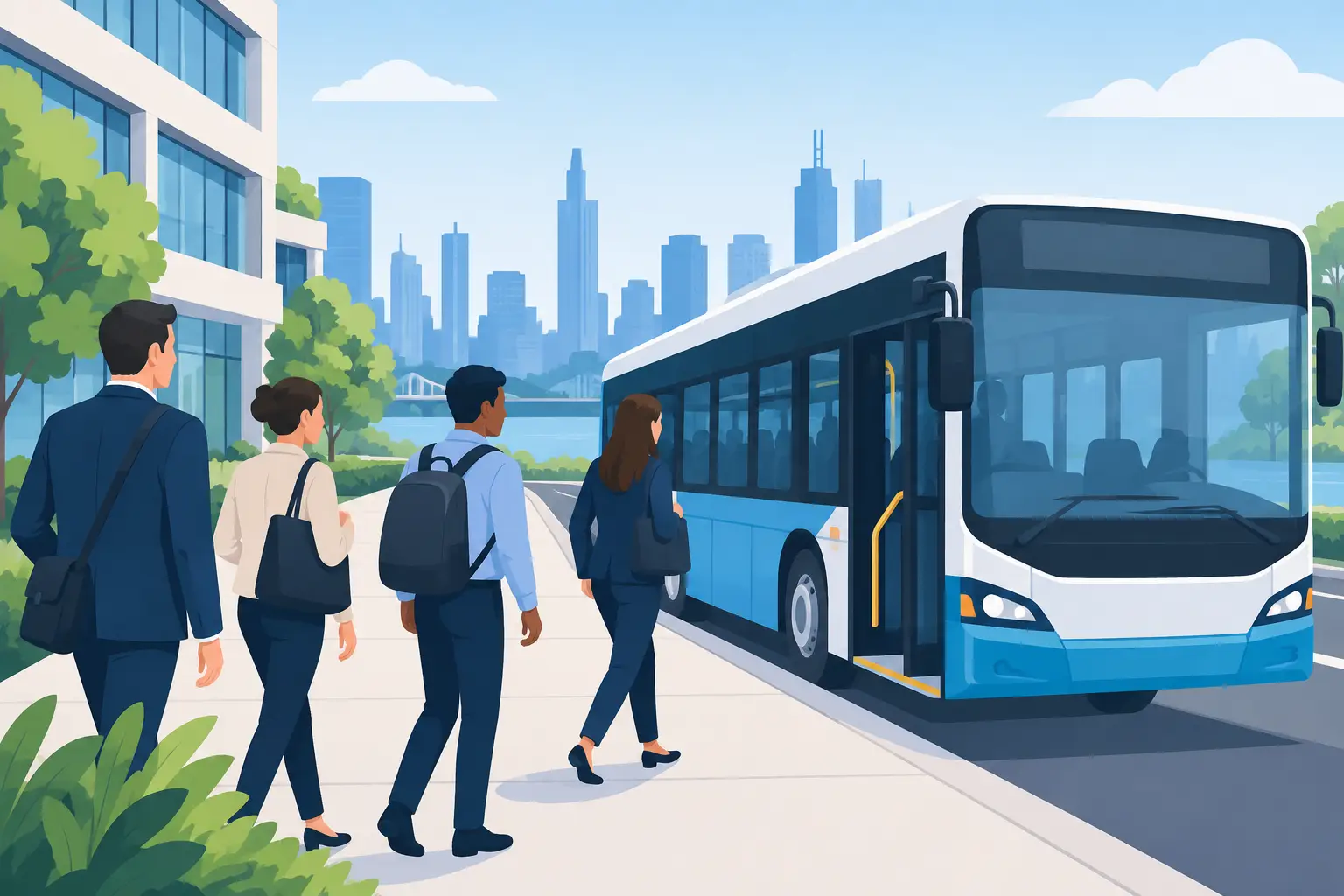
A staff shuttle that arrives five minutes late can quickly become a delayed shift change, a missed meeting, or a line of employees waiting in the rain. Knowing how to plan staff transport means treating the trip as part of your workday operation, not as an afterthought. The right plan gives employees a clear pickup point, a dependable schedule, and a comfortable ride, while giving managers one less moving part to chase.
For workplaces across Melbourne, the Mornington Peninsula, the Yarra Valley, and Country Victoria, a driver-led bus can replace fragmented carpooling, parking issues, and inconsistent arrivals. Whether you need a daily work shuttle, transport for a regional project, or a one-time staff event, the planning process starts with the people traveling and the timing they need to keep.
Start with the purpose of the trip
Before choosing a vehicle or setting a route, define what the service must achieve. A recurring shuttle from a train station to an industrial site has different requirements from transport for a conference, staff celebration, or off-site training day.
For a daily or weekly work service, reliability and repeatable timing are usually the priority. Employees need to know where to wait, how long the journey takes, and what happens if their shift runs late. For a single event, the focus may be on getting everyone to the same venue on time and providing a safe way home afterward.
Write down the essential details: the travel date or service period, shift or event start time, pickup location, destination, expected finish time, and whether a return transfer is required. If your destination is regional, include all planned stops rather than assuming the route can be decided on the day.
Confirm passenger numbers before booking
Passenger count is the decision that shapes every other part of the booking. Ask employees to confirm their place by a set deadline and allow for a sensible buffer if participation is likely to change. It is better to plan around confirmed travelers than an informal estimate passed around by several departments.
Vehicle size should match the group without paying for unnecessary empty seats. A 12-, 14-, or 21-seat bus can suit a small site team, airport transfer, or management group. A 25- or 34-seat bus may suit a department traveling together, while 45-, 48-, 50-, and 57-seat buses are practical for larger workforces, conferences, and staff events.
There is a trade-off. Booking too small can leave employees behind or force a second vehicle at short notice. Booking much larger than needed can add cost and make narrow-site access more difficult. If the final number is uncertain, tell the transport provider the expected range when requesting a quote. They can help you select a capacity that works for the likely attendance.
Choose pickup points people can actually use
The most efficient route is not always the best staff transport route. A single central pickup point simplifies scheduling, but it only works if employees can safely and realistically reach it. Consider public transit connections, available parking, lighting for early starts, pedestrian access, and whether people will be carrying work equipment.
For a workplace shuttle, common options include a major station, a park-and-ride location, a central office, or a designated pickup near a staff parking area. Keep the number of stops low where possible. Every additional stop adds travel time and creates another opportunity for delay.
If multiple pickups are essential, put them in a logical order based on geography and shift times. Share the final pickup timetable with staff well before the first service. Include the address, a clear landmark, the departure time rather than only an arrival window, and a contact process for urgent issues.
Allow realistic travel time
Build the schedule around real conditions, not the best-case travel time shown on a map. Peak-hour congestion, school zones, roadworks, event traffic, and regional roads can all affect a journey. This matters particularly for early shifts, major Melbourne events, and trips to destinations such as the Yarra Valley or Mornington Peninsula.
Aim to have staff arrive with enough time to walk in, sign on, collect equipment, or settle before work begins. For a corporate event, arriving 15 to 20 minutes early is usually more useful than having everyone step off the bus at the exact start time. Return trips need the same attention, especially when finish times are flexible or people may leave in stages.
Plan the route around work requirements
A driver-led charter works best when the itinerary is specific. Provide the full destination address, entry gate or loading area, preferred approach route if your site has one, and any access rules. Warehouses, construction sites, schools, hospitals, and industrial estates may have vehicle restrictions or designated bus bays.
Let the driver and transport provider know about site induction requirements, security check-in, height restrictions, narrow driveways, or times when heavy vehicles move through the area. This prevents avoidable delays and helps confirm whether a larger bus can safely access the property.
For regional projects or training days, consider whether the group needs one direct transfer or transport between several locations. A direct route reduces travel time. An itinerary with planned stops can be more convenient, but it needs firm timing and a nominated organizer who can keep the group moving.
Make shift changes and return travel clear
Staff transport often fails at the end of the day, not the beginning. A delayed shift, overtime, weather event, or late-running presentation can affect the return transfer. Decide in advance how much waiting time is included, who can approve a schedule change, and how staff will be notified if the departure time moves.
For shift-based operations, a short overlap between the bus arrival and shift start can protect the roster when traffic is unpredictable. If separate day, afternoon, and night services are needed, treat each as its own route and passenger group. The same pickup location may work, but the traffic conditions and safety considerations can be very different after dark.
A designated workplace contact should have the driver’s service details and authority to communicate changes. Employees should know that the bus leaves at the stated time unless a revised instruction is issued. Clear expectations are fairer to the people who arrive on time and help the service run consistently.
Include comfort, safety, and practicality
Staff are more likely to use a transport service when it makes their day easier. Check whether passengers will have bags, laptops, uniforms, safety gear, or presentation materials. A full bus carrying equipment may need more room than the headcount alone suggests.
Think about the conditions around the trip. Early morning or late-night pickups need a safe waiting area. Long regional journeys may need a planned comfort stop, depending on the itinerary and group. For events involving alcohol, booking a bus and professional driver gives staff a coordinated way to travel without relying on designated drivers or separate cars.
Accessibility needs should be discussed early. Ask employees privately if they require assistance or have mobility considerations, then provide the relevant information when arranging the service. The earlier this is raised, the easier it is to select a suitable vehicle and pickup arrangement.
How to plan staff transport with a clear brief
A detailed booking brief saves time and leads to a more accurate quote. Include the service date, number of passengers, vehicle size preference if you have one, pickup and drop-off addresses, requested departure and return times, and whether the trip is one-way, return, or multi-stop. Add any site access instructions and the name and phone number of the person coordinating on the day.
For recurring transport, explain the days of operation, shift patterns, expected passenger changes, and the date the service should begin. For one-off events, include the event schedule and the point at which all guests must be collected. This lets the operator plan a vehicle and driver around the job rather than making assumptions.
Bus and Driver Hire can provide driver-inclusive transport across Victoria for small groups through to larger staff parties. Request a quote with the details you have, even if a few elements are still being finalized. A clear conversation early can identify route or capacity issues before they become a problem on the day.
The most useful next step is to nominate one transport contact, confirm your passenger list, and send the trip details early. When everyone knows where to be and when to be there, staff transport becomes a reliable part of the workday rather than another task for your team to manage.