
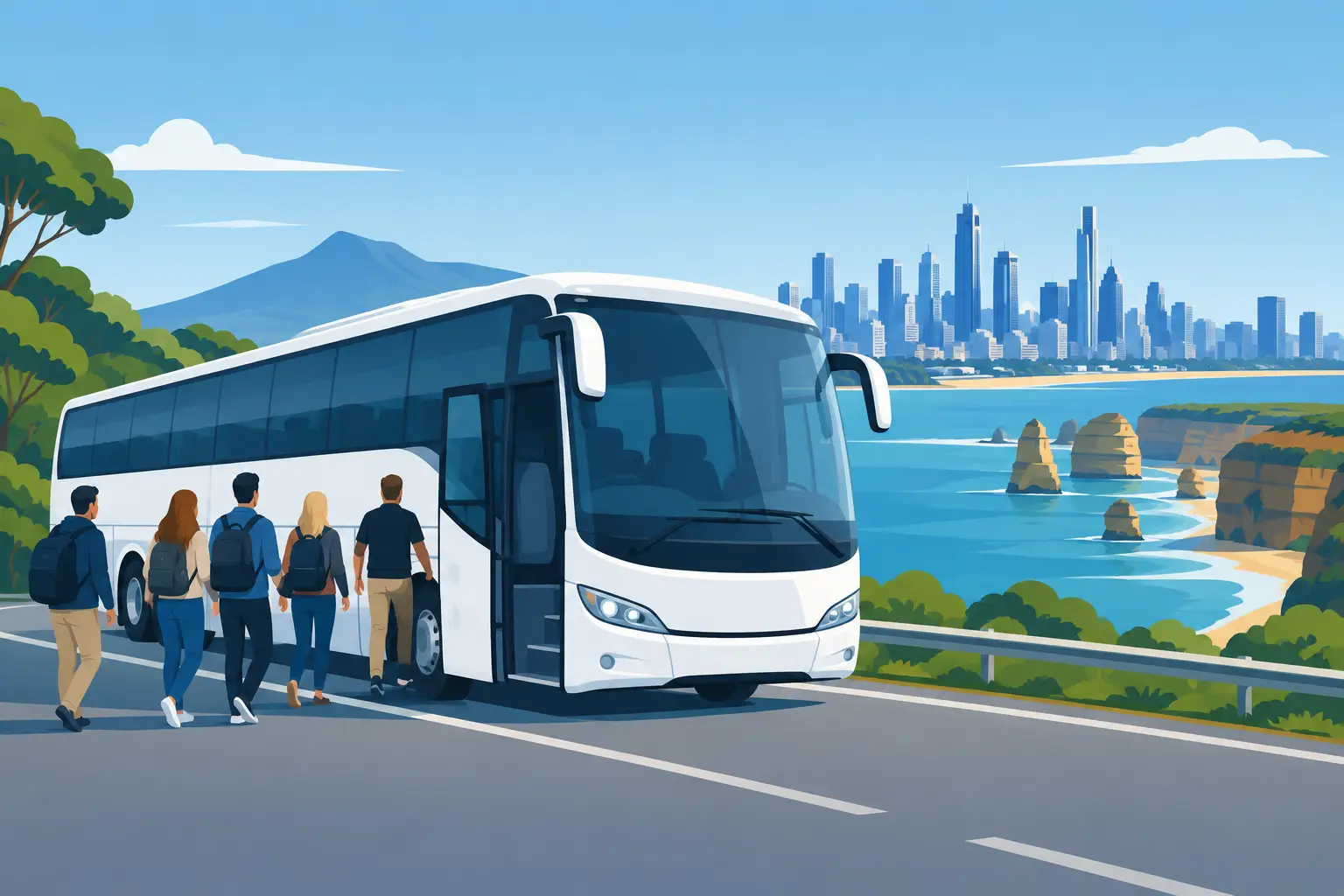
When 40 guests are expected at a Mornington Peninsula wedding or 55 staff members need to reach a regional site on time, transport is not a detail to leave until the final week. The best buses for large groups are the ones that match your actual passenger count, luggage needs, route, and schedule – with a professional driver managing the road while your group stays together.
For organizers in Melbourne and across Victoria, a single well-sized charter bus can replace a long line of cars, remove parking pressure, and give everyone one clear arrival time. The right choice is rarely just the biggest vehicle available. It is the bus that gives your group enough space without paying for capacity you will not use.
What makes a bus right for a large group?
Large-group transport starts with a reliable headcount. Ask guests or staff to confirm early, then allow a small margin for late additions where possible. A group of 32 usually suits a 34-seat bus better than a 45-seat coach. A group of 44, however, needs the comfort and certainty of a 45-, 48-, or 50-seat option rather than trying to make a smaller vehicle work.
The route matters just as much as the seat total. A straightforward Melbourne airport transfer may have different requirements from a full-day Yarra Valley itinerary with several winery stops. For weddings, consider whether guests will be traveling with bags, prams, formalwear, or personal items. For corporate travel, consider pickup points, shift times, and whether the return trip will carry the same number of passengers.
A driver-inclusive charter also changes the experience. Rather than asking a guest to navigate unfamiliar regional roads or appointing several designated drivers, everyone can travel together and arrive ready for the occasion.
Best buses for large groups by passenger count
A capacity-led approach makes booking easier. Start with the number of seated passengers, then select the nearest practical bus size above that number.
Groups of 34 to 45 passengers
A 34-seat bus is a sensible choice for medium-to-large wedding guest transfers, corporate functions, sports teams, and day tours. It is large enough to keep a substantial group together while remaining practical for many venue access points and city pickups.
For groups approaching 40 passengers, a 45-seat bus gives more breathing room. This can be particularly useful for a winery tour, a family celebration, or an event where the final attendance figure may change. Avoid booking exactly to your expected maximum if you are still waiting on several responses. A few spare seats are usually less stressful than arranging a second vehicle at short notice.
Groups of 46 to 50 passengers
A 48- or 50-seat bus suits major wedding transfers, workplace outings, school-age family groups, conference movements, and larger regional day trips. These vehicles are a strong fit when keeping the group in one vehicle is a priority.
One-bus travel helps the organizer as much as the passengers. There is one pickup schedule, one driver point of contact, and no need to track whether a second vehicle has fallen behind in traffic. For events with a firm start time, that coordination can be the difference between a calm arrival and a stream of late phone calls.
Groups of up to 57 passengers
For the largest single-bus groups, a 57-seat vehicle is often the practical answer. It is suitable for large corporate transfers, staff movements, extended family events, major wedding guest lists, and groups traveling to regional destinations such as the Yarra Valley or Mornington Peninsula.
A 57-seat bus is not automatically the best choice for every party of 50. If pickup access is tight, the itinerary includes narrow local roads, or passenger numbers are likely to drop, a 50-seat vehicle may be a better fit. Give the transport provider the full itinerary so vehicle suitability can be considered alongside capacity.
Match the vehicle to the trip, not just the headcount
The most successful group charters are planned around how people will actually travel. A bus for a corporate transfer may need to collect employees from one central Melbourne location and deliver them to a venue at a precise time. A work shuttle may operate on a recurring timetable, requiring consistency more than a complex itinerary.
Wedding transport often works best with defined transfer windows. For example, a bus can collect guests from accommodation, take them to the ceremony, return them after the reception, or complete both outward and return movements. Clear pickup times help prevent guests from driving after celebrating and reduce the chance of people getting lost between venues.
For winery and regional tours, build realistic travel time into the day. The Yarra Valley and Mornington Peninsula reward a relaxed itinerary, but distances between venues, meal stops, and pickup locations still need to be accounted for. A packed schedule may look efficient on paper while leaving little time to enjoy the experience. Fewer well-chosen stops often create a better day than trying to visit every venue on a list.
Details to confirm before requesting a quote
A tailored quote will be more accurate when you provide the key trip information from the beginning. Include your travel date, preferred pickup time, pickup and drop-off locations, estimated passenger count, and whether you require a return transfer or multiple stops.
It also helps to mention any timing constraints, such as a ceremony start, flight arrival, conference session, or shift change. If the group has luggage, mobility requirements, young children, or a particularly late finish, raise this during the inquiry. These details influence the most appropriate vehicle and schedule.
For larger events, nominate one organizer as the main contact on the day. That person can communicate any last-minute instructions and make sure passengers know where to meet. A simple group message sent the day before should confirm the pickup address, departure time, expected return time, and a reminder not to be late.
When two buses may be the better option
Keeping everyone on one large bus is convenient, but it is not always the best operational choice. Two smaller buses can work better when guests are departing from separate areas, when an event has staggered finish times, or when venue access limits larger vehicles.
This is common for weddings with guests staying at different hotels, workplaces with staff finishing different shifts, and multi-location corporate events. It can also help when a group includes people who need to return earlier than others. The trade-off is added coordination, but the result may be a more practical service for passengers.
Bus and Driver Hire can match groups with 12- to 57-seat vehicles and professional drivers for transfers, charters, regional tours, work shuttles, and events across Melbourne and Victoria. Sharing the full plan makes it easier to recommend the right capacity rather than simply the largest bus.
Give your group one clear plan
The right bus gives your guests or staff more than a seat. It gives them a known pickup point, a shared timetable, and a safe way to travel without managing parking, navigation, or multiple cars. Request a quote with your date, group size, and itinerary, then choose a vehicle that leaves enough room for the day to run as planned.